
Littleton, CO · Roofing service
Hail Damage Roof Repair in Littleton, CO
Documented hail inspections for Front Range storm damage, with the photo evidence and measurements an adjuster actually needs.
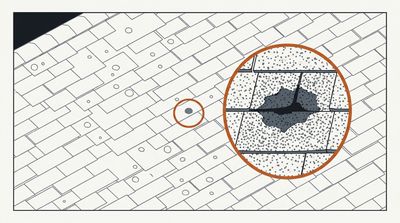
Hail damage is mostly invisible, and that is the problem
Hail rarely punches holes in a roof. It bruises the mat beneath the granules, so the shingle keeps its shape while losing waterproofing life. The failure surfaces one or two freeze-thaw seasons later, which is why a roof can look perfect from the driveway and still be a total loss on an adjuster's report.
This single fact drives almost everything that goes wrong for homeowners after a Colorado hail storm. You cannot see the damage, so you rely on someone else to tell you it is there. That creates an opening for both under-reporting and wild over-reporting, and after a big storm you will meet people doing each.
Why the Front Range is different
The Colorado Front Range records the highest frequency of large hail in North America. Hail season runs roughly mid-April to mid-September.
Littleton's building code reflects this indirectly. The city's adopted design criteria of 40 psf, non-reducible ground snow load and 136 mph ultimate design wind speed, plus the ASTM D7158 Class H requirement and the six-nail minimum, all exist because roofs here take a beating that roofs in milder climates do not.
What we look for
Soft metals first
Vents, flashings, gutter aprons and gutter faces dent before shingles show visible damage. They are the most reliable dating evidence on the whole roof, because a dent in aluminum does not appear from age.
If the soft metals are clean, we are sceptical of a claim. If they are peppered, we know the storm hit this roof and we know roughly how hard.
Then the field
Hail bruises are circular, often with granule displacement at the center, and they feel soft when pressed — like a bruise on fruit. The mat underneath is fractured even though the surface is intact.
We count impacts within measured test squares across each slope, because density and distribution are what adjusters assess. A slope with scattered marks and a slope with consistent bruising are different findings with different outcomes.
Then everything else
Ridge caps and hip shingles take disproportionate damage because they are exposed on two sides. Skylight domes, pipe boots, swamp cooler housings and the underside of eave returns all tell part of the story.
We also check the areas that are not damaged, and we photograph them. A report that only shows damage looks like advocacy. A report that shows the whole roof looks like evidence.
What you get from us
- Photographs of every slope, including undamaged areas, with orientation noted.
- Test square documentation with impact counts.
- Soft metal evidence, photographed close.
- A written assessment of what we found and what we think it means.
- Our availability to meet your adjuster on the roof.
That documentation is yours regardless of whether you hire us for the work.
What we will not do
- We will not cover your deductible. It is fraud, and the claim is in your name.
- We will not promise your claim will be approved. Your carrier decides that.
- We will not negotiate with your insurer on your behalf. That is a licensed activity in Colorado and a roofer is not the one to do it.
- We will not tell you there is damage when there is not to get on your roof.
- We will not ask you to sign a contingency agreement on the doorstep before anyone has inspected anything.
After a significant storm, out-of-state crews arrive in the metro within days. Some are competent. The test is not how confident they sound on your doorstep, it is whether they will exist in three years when your roof needs a warranty call.
What happens after the claim
If your carrier approves a replacement, the work is a full roof replacement under Littleton's normal requirements: tear-off to deck, six nails per shingle, Class H product with manufacturer documentation at permit intake, ice barrier two feet inside the wall line, final inspection.
An insurance job is not a lesser job. The same code applies, the same permit is pulled and the same inspector attends.
If your home has solar, factor in the sequencing early: the roof permit is held until a city-licensed solar contractor permits the array removal and replacement.