
Littleton, CO · Roofing service
Flat and Low-Slope Roofing in Littleton, CO
TPO, EPDM and modified bitumen. Mineral-surfaced roll roofing is not permitted in Littleton, so we detail what legally replaces it.
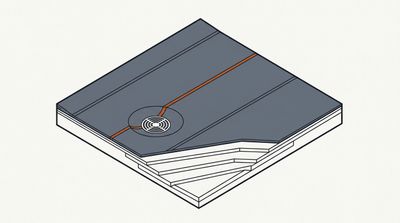
Flat roofs play by different rules in Littleton
Littleton treats low-slope and membrane roofing under a separate section of its policy from shingle, metal and tile. The headline differences: membrane overlays are permitted where shingle overlays are not, and mineral-surfaced roll roofing is not permitted in the city at all.
That second point is the one that catches homeowners. Roll roofing is cheap, widely available and commonly used on sheds, porch roofs and small additions across the metro. In Littleton it is not a legal covering.
Where the pitch line falls
Asphalt shingles may not be installed below 2/12 pitch. Between 2/12 and 4/12 they are allowed but need double underlayment or ice and water barrier.
This matters because low-slope areas are frequently attached to otherwise ordinary houses: a porch roof, a rear addition, a dormer connection, a garage that was extended. Someone shingles it to match the main roof, it is below 2/12, and it leaks persistently for years while everyone looks for the leak in the wrong place.
If you have a section of roof that keeps leaking no matter how many times it is patched, the first question worth asking is what pitch it actually is.
What is permitted
| Covering | Littleton status |
|---|---|
| Modified bitumen | Acceptable |
| Membrane systems (TPO, EPDM and similar) | Acceptable, and overlays permitted |
| Liquid-applied overlay | Permitted, with an approved product submittal before permit issue |
| Mineral-surfaced roll roofing | Not permitted |
TPO
A single-ply thermoplastic membrane, heat-welded at the seams. Reflective white surface, which matters at Colorado's altitude and UV exposure. Welded seams are the strength of the system: done properly they are as strong as the sheet.
EPDM
Synthetic rubber, typically dark, seamed with adhesive or tape. Long track record and very tolerant of movement. The dark surface absorbs heat, which is a consideration on a conditioned space below.
Modified bitumen
Asphalt-based sheet reinforced with polyester or fibreglass, in torch, cold-adhesive or self-adhering forms. Explicitly acceptable in Littleton. Often the sensible answer on small residential low-slope areas where a single-ply membrane would be awkward to detail.
The overlay exception
This is worth stating clearly because it contradicts what is true everywhere else on a Littleton roof.
On asphalt, metal and tile, Littleton requires full tear-off and accepts no overlays. On membrane roofing, overlays are permitted.
If the existing membrane is sound, dry underneath and structurally adequate, overlaying can be a legitimate and considerably cheaper option. The conditions matter: trapped moisture under a new membrane has nowhere to go and will destroy the assembly from beneath.
Liquid-applied overlays carry an extra step. The product submittal has to be approved by the Building Division before the permit is issued and before work commences. That is lead time to plan for, not a formality to handle on the day.
Drainage is the whole job
A flat roof is never actually flat. It is a low-slope roof that must move water to drains or scuppers, and standing water is the enemy of every system on this page.
Ponding accelerates membrane degradation, adds dead load, and finds any seam weakness by sitting on it continuously. When we assess a flat roof, slope and drainage get looked at before covering condition does, because a system that ponds will fail early regardless of what it is made of.
Common findings: drains set above the surrounding surface, insulation that has compressed and created a low spot, scuppers sized for less rain than a Front Range summer delivers, and additions built without adequate fall in the first place.
Commercial work and the warranty certificate
For commercial membrane roofing, Littleton requires a final roof inspection by the Building Division and a warranty certificate provided and attached to the building permit before the final is approved.
A third-party engineer's observation letter is not accepted in place of a final inspection without prior authorization from the Chief Building Official.
Snow and wind loads for commercial projects are determined by the online ASCE Hazard Tool, using the version of ASCE 7 referenced in the currently adopted I-Codes, rather than by the fixed residential figures.
Installation guidelines must be submitted at permit application and be available on site at every inspection. Where manufacturer instructions and adopted code conflict, the more restrictive requirement applies.